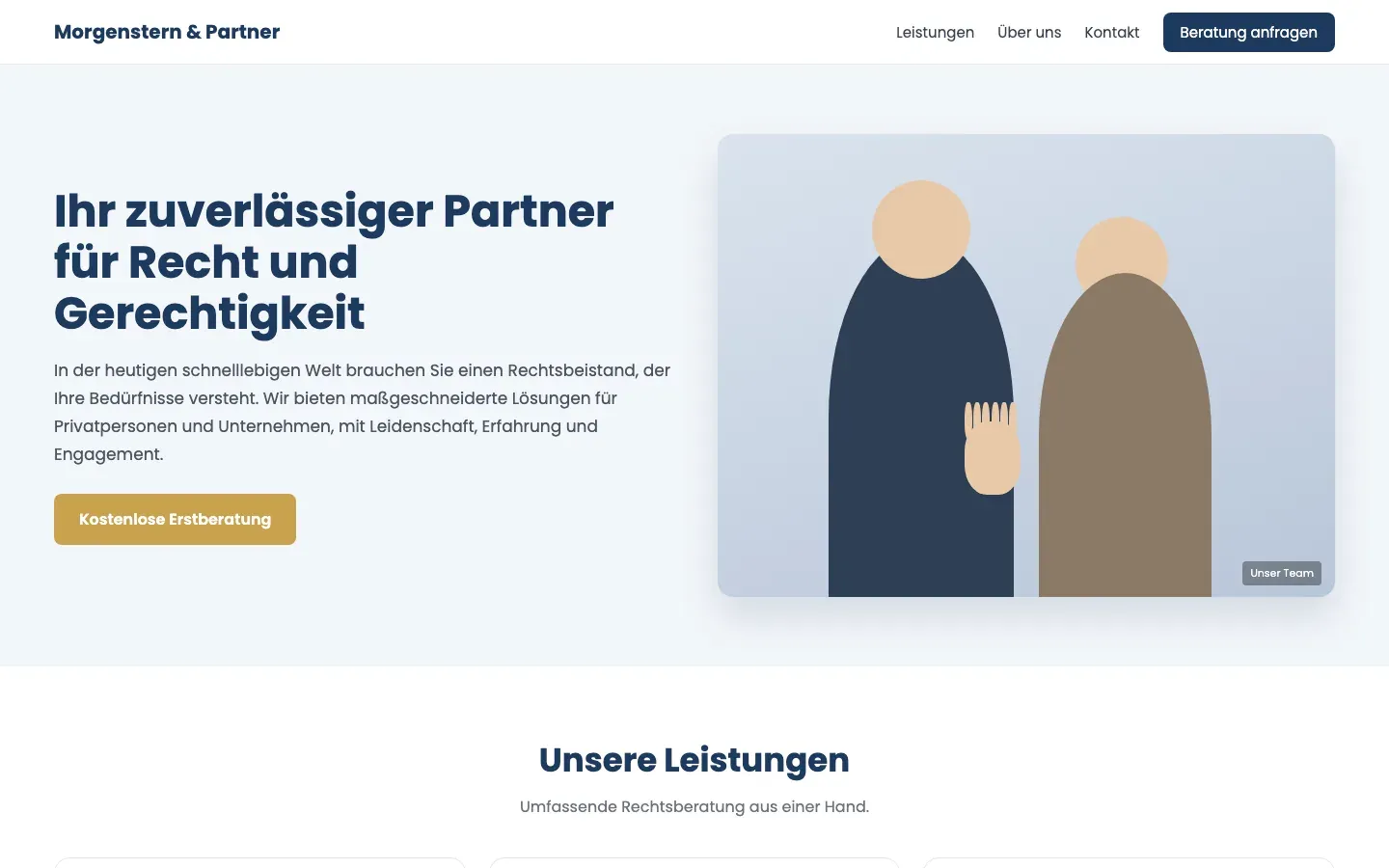
What it looks like
Smiling people with poreless skin and the same lighting on every face, presented as the team, the patients or the customers. On a closer look: a hand with six fingers or two thumbs, an earring that melts into the jaw, glasses whose frames do not meet, a lanyard with text in no language, teeth that do not line up with the lips. The group photo has twelve people and nobody is looking at the same point.
Why it gives a page away
Real stock photography already lied about who works here. Generated people lie further and worse: a fabricated human is presented as a real one, on the page that is supposed to prove a real business stands behind it. That makes it the strongest imagery tell, and in a clinic or a law firm it is a trust problem before it is a design one.
How to check your own site
Zoom in on every portrait: hands, teeth, ears, jewellery, lanyards, name badges and anything with letters on it. Then ask who the person is. If nobody on the team can name them, they are not on the team.
What a designer would do instead
One real photograph of one real person, taken in the actual room, even on a phone, beats a gallery of generated faces. If nobody wants to be photographed, show the place, the work or the tools, and say who you are in words.
When it is not a tell
Illustration that is clearly illustration, used as illustration. The tell is a synthetic photo presented as a document of a real person.
Other tells in imagery
- Generic 3D illustrations: Floating isometric shapes, rockets, gears, chat bubbles and coins, rendered in pastel plastic, illustrating nothing in particular.
- Illustrations from three different worlds: Flat vector people in one section, a 3D render in the next, a photo in the third, each in a different palette and line weight.
- Not one real photograph: Nothing on the site shows this business's actual place, people, product or work.